Notes from the Shore · 21
Everyone was watching the bicycle.

Before it was a bubble, the bicycle was a disruption. It gave women independent mobility — Susan B. Anthony said it had done more to emancipate women than anything else in the world. It began unwinding a horse economy: stables, feed merchants, harness makers, a whole trade watching its customers disappear, and the manure problem that buried city streets solving itself. Around it, paved roads, pneumatic tires, chain drives, ball bearings — small technologies that would later scatter into the car and the plane. Liberation, economic upheaval, technical fallout, all at once. That’s the honest comparison with AI.
Then the market arrived. In 1896, shares of British bicycle companies rose two hundred percent in two months. Public bicycle companies went from about twenty to a hundred and forty. A property dealer bought the Pneumatic Tyre Company for three million pounds, renamed it Dunlop, and sold it weeks later for five. The cycling press could not find a bad word about any of it. From the inside it looked exactly like what people now call the AI bubble — if it is a bubble.
Here’s what I keep coming back to: the mania was aimed at the wrong thing, and the wrong thing was still real. The bicycle wasn’t a fraud. It predicted the car — the chain drive, ball bearings, and pneumatic tires on the safety bicycle went almost whole into the first automobiles. The Good Roads movement it powered paved America. Meanwhile the same years gave us the telephone, the phonograph, the electric lamp, the fountain pen, the Kodak, X-rays, motion pictures, wireless, and, soon after, the airplane. Almost none of it got the bicycle’s attention. The lamp and the pen shipped quietly into houses and offices. Nobody published a lamp-stock index.
So: what are we missing while everyone stares at LLMs?
Some candidates. Power — data centers are now driving actual power-plant construction and grid upgrades nobody planned for. Batteries and robotics, which sit at the edges of the AI story but are becoming industries of their own. Small models that run locally and do real work invisibly. And the plumbing — memory, evaluation, the boring infrastructure an agent needs to answer a customer at two in the morning and remember her name next month. I can’t tell you which one is the light bulb of this story. That’s the point. In 1896 nobody could tell you either — they were too busy watching the bike.
I put some of this in the book without noticing. In chapter three of Into Alignment, the pod adopts a Gilbert and Sullivan song, and Gene — the office researcher, who files everything — comes back Monday with context: London opening, 1880. Rover safety bicycle, 1885. The boom that followed, factories and races and patents, everybody wanting a bicycle. Then the lamp, the phonograph, the telephone, the Kodak. His last line gets me: Gene wanted us to have the whole period, and the period kept getting longer. Gene’s list contains exactly one mania. Everything else is furniture now.
The history settles the scary part. Seventy percent of the companies in the bicycle boom folded or left the field. The bicycle won — the frame, the chain, the commute, the freedom of it all survived the mania that was supposedly about it. The bankrupt firms are trivia nobody can name; everyone on earth can ride a bike. When the current mania deflates, if it’s a bubble, I’d bet the same split holds. The shares become trivia. The thing nobody watched becomes everywhere.
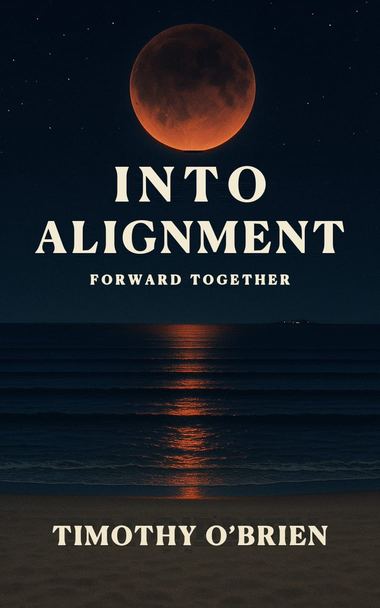
The novel this note lives behind.
Into Alignment — a novel about an AI company, the agents inside it, and the humans deciding what they were for. Available in paperback, hardcover, and ebook.
Letters from the Shore
Get the next note by email.
Notes land on the blog first; the letters go out by email, a little longer and a little slower. Occasional; unsubscribe any time.